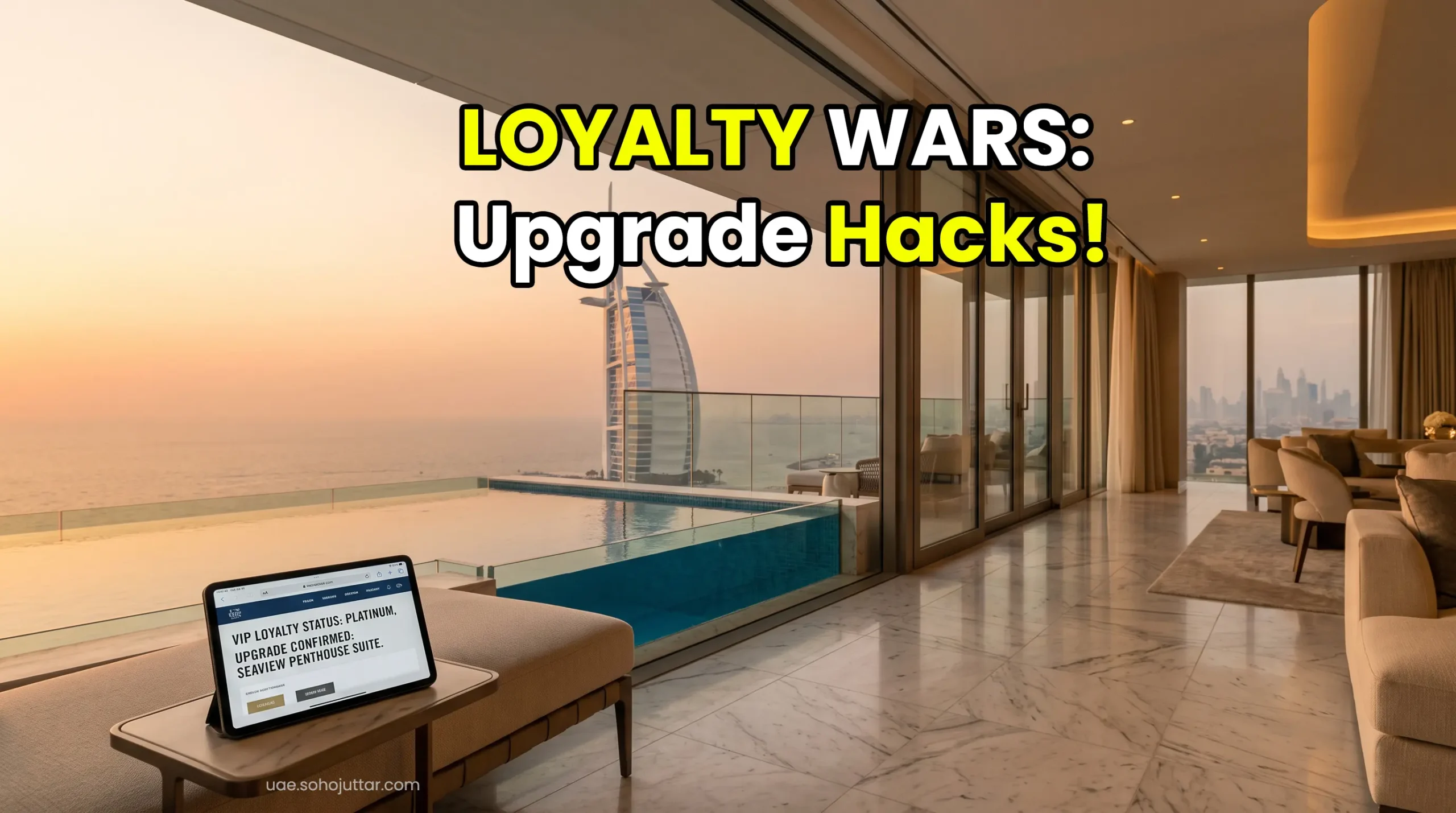
⚡ Quick Bites (TL;DR)
Pro Tip: The September transition shifts pricing power back to elite travelers. Marriott Bonvoy’s global volume algorithm favors early check-ins and late check-outs, while Jumeirah One’s localized engine heavily rewards on-property dining and spa expenditures to trigger unadvertised suite elevations.
Strategic Warning: Booking entry-level inventory through third-party platforms entirely strips your direct elite benefits in both ecosystems. To secure guaranteed lounge access and property-specific suite upgrades, reservations must be executed directly through the proprietary hotel APIs.
Critical Alert: Proprietary points redemptions eliminate the baseline room rate but do not negate statutory taxation. The mandatory UAE property service charge, local municipality fees, and the daily Tourism Dirham will still be physically collected upon departure.
The operational dynamics of ultra-luxury hospitality within the United Arab Emirates dictate that true elite travel requires profound distribution intelligence. As the aggressive summer heat softens into the highly anticipated September transitional window, the world’s most prestigious mega-resorts aggressively pivot their revenue strategies. During this exact thirty-day corridor, properties prepare for the massive influx of fourth-quarter global tourism by shifting focus toward high-net-worth domestic residents and regional expatriates. While massive external aggregators dominate the retail market, the ultimate battle for structural prestige, penthouse assignments, and executive lounge access is waged entirely within proprietary digital ecosystems. For elite travelers evaluating their early autumn portfolio, navigating the complex algorithms of UAE 7-star luxury staycations requires mastering the contrasting architectures of localized giants and global mega-brands.
The definitive luxury comparison in the Middle East pits the hyper-localized exclusivity of the Jumeirah Group against the sprawling, globally dominant matrix of Marriott International. Both organizations command the most coveted architectural assets across Dubai and Abu Dhabi. However, their property management systems process elite status, suite upgrades, and VIP concierge prioritization through entirely different mathematical lenses. Deconstructing the precise differences between the revenue-driven Jumeirah One system and the volume-driven Marriott Bonvoy architecture allows discerning guests to systematically optimize their travel capital, guaranteeing palatial accommodations before international winter rates lock in.
Deconstructing the Jumeirah One Exclusivity Matrix
Jumeirah operates the absolute crown jewels of the Dubai hospitality sector, most notably the iconic Burj Al Arab and the sprawling, canal-laced Madinat Jumeirah complex. Unlike global chains that manage thousands of standardized properties, Jumeirah maintains a highly concentrated, fiercely exclusive portfolio. Consequently, the Jumeirah One algorithm does not prioritize sheer room night volume; it is ruthlessly revenue-driven. To trigger the highest echelons of this program—specifically the Gold and Platinum tiers—a traveler must demonstrate a history of exorbitant incidental expenditure.
The property management system at Jumeirah Al Naseem or Jumeirah Zabeel Saray heavily tracks on-property Michelin-star gastronomy, ultra-premium private beach cabana rentals, and high-end holistic spa therapies. When a Jumeirah One Platinum member books a standard ocean-facing room during the early September shoulder season, the revenue manager manually reviews the profile’s historical incidental yield. Because the algorithmic data indicates this specific guest will spend thousands of dirhams in the resort’s high-margin culinary venues, the hotel forcefully overrides automated inventory systems to allocate signature multi-room suites. This proprietary ecosystem is designed to lock high-net-worth individuals into a closed loop of uncompromised luxury, offering a level of bespoke domestic prestige that even sophisticated third-party tactics like Booking.com Genius Dubai struggle to replicate within this specific brand.
The Marriott Bonvoy Global Volume Engine
In stark contrast to Jumeirah’s localized revenue model, the Marriott Bonvoy architecture—particularly at the Titanium and Ambassador Elite tiers—is a mathematical juggernaut built on sheer global volume. When a corporate executive utilizes the Marriott ecosystem, they are plugging into a massive, homogenized API that governs St. Regis, The Ritz-Carlton, Bulgari, and The Luxury Collection properties across the Emirates. In the UAE, this translates to formidable leverage at ultra-luxury outposts such as The St. Regis Saadiyat Island Resort and The Ritz-Carlton Dubai.
The Marriott algorithm processes suite upgrades through a highly automated, predictive matrix. Exactly seventy-two hours prior to arrival, the property management software scans the incoming manifest. It calculates the ratio of available standard suites against the volume of arriving Titanium and Ambassador members. During the lower-occupancy weeks of early September, the system automatically processes the elevation, pushing a digital notification directly to the guest’s mobile application. This automated execution removes human negotiation from the process. Furthermore, top-tier Marriott status guarantees absolutely unrestricted access to the Executive Club Lounge regardless of the final room category booked. For families and corporate teams, this translates to massive financial subsidies on daily premium culinary spreads, afternoon tea services, and dedicated concierge assistance.
💎 Mizanur’s VIP Booking Hack
To forcefully trigger an Ambassador-level suite upgrade at a Marriott luxury property during September, deploy the “Suite Night Award (SNA) Decoy” maneuver. Exactly five days before arrival, apply your accrued SNAs to your reservation through the digital application. The algorithm will immediately sequester a premium suite for your profile. However, twenty-four hours before check-in, physically call the VIP concierge and politely request to cancel the SNA application while expressing immense excitement for your stay. The property management system will return your SNA certificates to your account, but because the local revenue manager has already assigned the physical room block and noted your high-touch engagement, they will frequently leave your profile hard-coded into the upgraded suite as a complimentary gesture of elite goodwill.
Strategic Deployment: Culinary Prestige vs. Executive Lounges
Determining which proprietary ecosystem to deploy during September requires a forensic analysis of your specific staycation objectives. If your primary mandate is securing guaranteed high-altitude executive lounge access, zero-friction automated upgrades, and guaranteed 4:00 PM late check-outs, the Marriott Bonvoy pathway is mathematically superior. The sheer scale of their UAE footprint ensures high probability metrics for suite elevations before the massive global tourism wave arrives in October.
Conversely, if your operational objective is absolute architectural isolation, access to the most elite private beach perimeters in the Middle East, and priority reservations at highly restricted culinary venues, you must deploy capital into the Jumeirah One network. Securing a bi-level suite at the Burj Al Arab or an oceanfront villa at Dar Al Masyaf provides a localized experiential yield that remains globally unmatched. Elite travelers often evaluate these direct bookings alongside palatial upgrades available through Expedia VIP Abu Dhabi platforms to ensure they are maximizing every aspect of their luxury portfolio.
The Anatomy of Private Villa Acquisitions
Over recent seasons, consumer preference among high-net-worth staycation seekers has shifted decisively toward standalone, secluded accommodations. Both Jumeirah and Marriott operate exceptional standalone assets, but their distribution strategies differ. Jumeirah keeps its most opulent beachfront residences tightly guarded, releasing them primarily to Platinum members or direct VIP concierge inquiries. Marriott, leveraging its vast Luxury Collection portfolio, often integrates its desert pavilions and pool villas into the standard automated upgrade pool during the September shoulder season.
Booking these secluded sanctuaries requires an advanced understanding of wholesale inventory cycles. Because the total inventory of standalone pool villas is inherently limited, automated dynamic pricing models react aggressively to booking spikes. To secure these exclusive sanctuaries without encountering inflated peak rates, travelers must master the specific booking pathways for private pool villas UAE collections, ensuring they capture the absolute lowest baseline before applying their proprietary loyalty status at the physical front desk.

Fiscal Clarity: Navigating Statutory UAE Taxation
A critical component of professional luxury travel planning is anticipating the statutory regulatory fees applied to hospitality folios across the Emirates. When finalizing reservations through digital distribution engines or redeeming proprietary loyalty points, baseline rates frequently exclude mandatory government charges, which are calculated sequentially upon final billing:
- Property Service Charge (10%): A standard operational hospitality charge applied across all food, beverage, wellness, and room services throughout the UAE.
- Municipality Fee (7% in Dubai, 6% in Abu Dhabi): A local government administrative fee levied on the total accommodation expenditure.
- Value Added Tax (5% VAT): The federal standard tax applied to the aggregated room rate and associated service fees.
- Tourism Dirham Fee: A flat statutory charge applied per bedroom, per night (typically 20 AED per night for 5-star and 7-star luxury hotel classifications).
Maintaining complete visibility over these statutory additions ensures that travel portfolios remain precisely budgeted, allowing guests to focus entirely on relaxation and uncompromised luxury during their September retreat.
Frequently Asked Questions: UAE Luxury Retreat Loyalty
Does Marriott Ambassador Elite guarantee a suite at The Ritz-Carlton Dubai?
While Ambassador Elite places you at the absolute top of the algorithmic priority list, suite upgrades remain subject to physical availability at the time of check-in. During the September shoulder season, the probability is exceptionally high, but signature multi-bedroom penthouses are usually excluded from automated upgrade pools.
Can I use Jumeirah One points to completely cover a stay at the Burj Al Arab?
Yes, Jumeirah One points can be deployed for reward nights across their portfolio. However, the algorithmic redemption rates for flagship properties are incredibly high. Elite members mathematically achieve better capital yield by using points to upgrade paid base rooms rather than booking outright reward nights.
Will booking a Marriott property through a third-party platform invalidate my Executive Lounge access?
Absolutely. If a Marriott Bonvoy Platinum or Titanium member books their stay through a third-party discount platform, the proprietary API legally strips all tier benefits. You will be denied complimentary access to the Executive Lounge and disqualified from all suite upgrade queues.
Does Jumeirah One offer a public status match program for UAE residents?
Jumeirah One operates a highly restrictive ecosystem and rarely offers automated public status matches. However, high-net-worth individuals can occasionally negotiate a tier upgrade by directly contacting the Jumeirah VIP relations team and providing proof of significant upcoming corporate event spend.
Are mandatory Dubai municipality fees waived when redeeming loyalty points?
No. Regardless of your proprietary loyalty tier or the volume of points deployed to cover the room rate, the 10% property service charge, the 7% Dubai municipality fee, and the daily Tourism Dirham are statutory UAE regulations that must be physically cleared upon departure.
